
Landon Bell: From Scholarship Recipient to Superintendent
 As labor shortages persist in the construction industry, one challenge has become increasingly urgent: finding skilled workers. To shed light on this issue, we spoke with Landon Bell, a young professional in the construction industry, and a superintendent at Branch Builds, to hear his background, vision, and perspective for the future of construction in the New River Valley.
Landon has long been involved with the New River Valley Home Builders Association, where he began volunteering with the NRV Home Expo and Touch-A-Truck NRV at an early age (his mom is on the Board of Directors). After receiving the 2017 NRVHBA Rick Whitney Memorial Scholarship, Landon committed to bringing his education and expertise back to the area.
However, his path wasn’t always a straightforward line to construction. He was initially drawn to architecture during his adolescent years and attended an architectural camp at Virginia Tech. He realized that the art and math-heavy computer work didn’t align with his interests and shifted to Virginia Tech’s Building Construction program.
His early work included roles at Blue Ridge Home Improvement, internship at James River Exteriors, work with Kesler Contracting doing on-campus renovations, and work with Avis Construction building an office building in the Virginia Tech Corporate Research Center.
Landon moved to Nashville prior to his junior and senior year of college to pursue an internship. With COVID happening during his senior year of college he stayed in Nashville and worked full time while completing his classes online. One of his key projects was the W Hotel, where he first started as an intern assisting the Superintendent. He quickly progressed to be the punchlist coordinator and eventually became the company representative for turning over spaces, managing client relations with Marriott and the general hotel manager.
During the five years he spent in Nashville, he also completed four other high-rise projects on the same street in the Gulch neighborhood. However, the W Hotel stood out to him because it had the greatest impact on his learning.

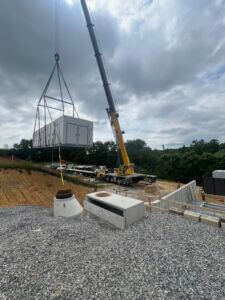
Now, back in Virginia, he served as a superintendent on the Christiansburg High School project, his alma mater, briefly during the summer of 2025 where he oversaw worker safety, project scheduling, and punch list completion. He is now the project superintendent on the $10.5 million HVAC replacement at the Christiansburg aquatic center.
Landon mentions the notable age gap in the construction industry, with many workers in their 20’s and 40’s-60’s, but fewer being in their 30’s. He also pointed to the succession concerns that could arise from this gap as previous generations retire and take their hands on experience and years of knowledge with them. Additionally, he highlighted the disconnect between college graduates and field experience, emphasizing that hands-on work is critical for understanding construction processes and developing communication skills and respect when working with crews.
 High school engagement, workforce development, and apprenticeship programs are crucial to addressing this labor shortage. Landon pointed to successful initiatives like the NRVHBA Building Futures Foundation and NRVHBA Apprenticeship Connection program, which help guide younger people towards careers in construction.
While financial assistance like the NRVHBA scholarship and a four-year degree can absolutely help accelerate one’s career progression, Landon emphasizes that practical experience is essential for long-term success. He encourages incoming construction professionals to explore different roles in the field and participate in apprenticeship and internship programs to gain a full understanding of the construction industry.
Landon’s journey, from NRVHBA scholarship recipient to construction superintendent in the New River Valley, reflects the value of mentorship, practical experience, and workforce development. As the construction industry continues to face labor shortages, his career serves as an example of how investing in the next generation can strengthen the local workforce and help ensure the industry’s future.